Sunday, July 18, 2010

St. James Town and Regent Park

Yesterday, despite the all-capital severe thunderstorm warnings garnering all the Toronto weather websites, I got the biking itch and decided to brave the possible storm and explore a few parts of the city that I hadn't seen. After reading John Sewell's The Shape of the City (a truly excellent book about the history of urban planning in Toronto), I became interested in checking out some of the housing projects that were created when urban planners had Le Corbusier on the brain and thought bull-dozing areas of the city and constructing towers amidst a sea of green grass was just the bees knees.

There were two places that I wanted to check out: Regent Park and St. James Town, done in the 1940s and 1950s, respectively. Both of these areas saw their streets systems destroyed along with whatever housing occupied the site. They are radically different from each other in look, but eerily similar in feel. My observations obviously stem from an initial bike through the site. I don't live in either of these areas and so can only speak as someone passing through.

St. James Town consists of a number of very tall, very imposing, very wide slab apartment buildings. I rode my bike down one of the "streets" that serves the area, craning my neck to get a good look at everything around me. It's not the most welcoming place as the buildings loom tall on all sides, cutting off light and the rest of the city. It feels very isolated inside St. James Town, as if you have entered another city. I put street in quotation marks because it's mainly a meandering set of curving roads that serve to connect a number of above and underground parking lots. A brick school is located in the centre that looks out of place amidst the towers. There was a farmer's market stand selling fruits and vegetables sitting alongside one of these roads and next to that a woman had plunked herself down on a concrete divider and was having a kind of yard sale sans the yard.


Image from WikiCommons by SimonP

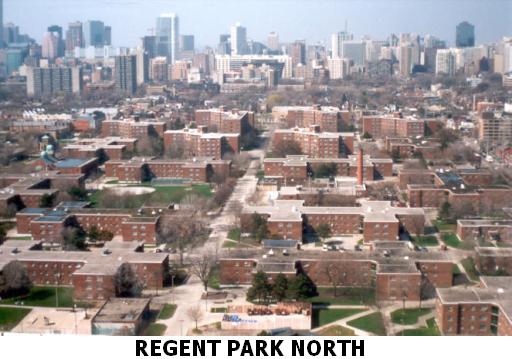
Further south east was Regent Park, which consists of low-rise apartments as opposed to the tall ones found in St. James Town. Most appeared to be three stories and made of a brick. Again, there were no real streets in the area (all having been destroyed during the original redevelopment), but only extended driveways that connected parking lots and walking paths that went to each of the apartment buildings. Again, the same feeling of stepping out of Toronto and into a completely different area appeared. Regent Park is all social housing with a large percentage of the occupants living at or below the poverty line.

The area is currently undergoing redevelopment in order to "undo" many of the ideas put in place by the planners of the 40s by restoring the street system and constructing housing that fits with the surrounding neighbourhood style. Market housing is also planned for the site to help pay costs. Hopefully these changes will see Regent Park become a more integrated part of the city.

What struck me most about these areas was how obvious it was you were exiting something and entering something else. There was a definable moment when I left Toronto and entered each of these housing projects, which is a feeling that I rarely (if ever) get when I bike or walk around other parts of the city. The worst thing to me about these areas is the lack of through streets, which I think is one of the main contributing factors to my disconnected feeling (and the fact that the housing looks miles different from the surrounding housing). It's like a separate box plunked in the middle of the existing street grid of Toronto. Why planners of the past thought wiping out the streets was a good idea, I don't know. Everyone loves streets. The farmer's market and yard sale in St. James Town prove that people want to be out on the street, even when what they have is an extended driveway.

Wednesday, July 14, 2010

Baby, it's hot outside

After having lived in Vancouver for a good 17 years, I had grown accustomed to 25 degrees being a hot summer day, but since uprooting myself over to Toronto I have had to reconfigure my ideas around what the word "hot" means.

Last week we had a heat wave here that saw temperatures at 33 or 34 degrees celsius with the humidity making it feel more like 44 degrees. Basically it's the kind of weather where upon exiting the shower you could spend the entire day towelling yourself. At some point, you just have to declare yourself "dry" and move on with your day. It's the kind of heat where if you open your mouth outside for just a second your tongue shrivels up into a raisin.

I can deal with heat, but humidity is another beast entirely. Still being new to the city, I wasn't exactly sure where to go to escape from this heat. The park certainly didn't help, even in the shade. The heat makes the city seem more daunting. What was once a short walk had become what could seem like an endless trek across the desert.

Heat waves seem to draw out all the people without air conditioning at home and distributes them at public/private institutions around the city. It would be interesting to see if the level of users of the library or mall shoppers spiked during heat waves. It could be good for business. So I found myself wandering the giant Eaton Centre mall downtown or lounging in the public library. I went into one city building and they even had a sign up that said "Emergency Cooling Centre". I should have gone to check it out, but I didn't. What goes on in there? Someone comes around with a block of ice and rubs it on the back of your neck?

Perhaps people in warmer climates will read this and roll their eyes. I'm sure I would; but for now I find myself sitting all day in my underwear watching the ice melt in my water.

Wednesday, June 23, 2010

How Walkable is Your Neighbourhood?

Yesterday, I stumbled upon a website that uses your address and calculates how walkable your neighbourhood is based on (surprise!) how often you would need a car for basic amenities. The score ranges from 100 (very walkable) to 0 (car dependent). Chances are you already know a bit how walkable your neighbourhood is so there probably won't be any real surprises here, but it's cool to see how your high or low your address scores. Even just for bragging rights.

My new apartment on the corner of Bloor and Spadina in downtown Toronto scores a 98%, leaving me with one of the highest. I'm not surprised by this score at all considering that to do most of my shopping I don't even need to cross a street and there is a subway entrance practically in my back alleyway that connects to two lines. Basically, it's the most convenient place I've ever lived, with the only negative being that I now view walking 2 blocks to get something as 'far away'.

My old place in Vancouver near East 8th and Grandview highway, gets a pretty good score of 89%, while my childhood home in White Rock, BC gets a resoundingly car-dependent 45% (something I knew all to well while growing up). This is a bit lower than the average score, which is a pretty deplorable 49%. Although, it would be interesting to see how much that average score changes if you only looked at urban areas or only at suburban.

Since I don't own a car and haven't driven since I was 18 years old, how easy a place is to walk, bike or use transit is pretty high on my list when looking for new digs. This website should help those that are planning to move and want to know how convenient the location is.

Here's a list, according to www.walkscore.com of what makes a neighbourhood walkable:

  • A center: Walkable neighborhoods have a center, whether it's a main street or a public space.
  • People: Enough people for businesses to flourish and for public transit to run frequently.
  • Mixed income, mixed use: Affordable housing located near businesses.
  • Parks and public space: Plenty of public places to gather and play.
  • Pedestrian design: Buildings are close to the street, parking lots are relegated to the back.
  • Schools and workplaces: Close enough that most residents can walk from their homes.
  • Complete streets: Streets designed for bicyclists, pedestrians, and transit.

Tuesday, June 22, 2010

Vomitorium: Fact or Fiction


Today I was sitting my wing back armchair reading Lewis Mumford's The City in History and generally pretending to be scholarly when I came across a section in Mr. Mumford's book describing the Roman vomitorium: the a room where gluttonous Romans went to purge themselves so they could eat even more. Say what?

After hours of studious research at the local public library (OK, fine, a two second search on wikipedia), I uncovered the shocking truth: Lewis Mumford was wrong. And there are even whole papers written about it from the American Philological Association. Apparently, although Romans did occasional vomit after a meal (and really, who hasn't?), the vomitorium as Mumford describes them did not exist.

But that doesn't mean the word doesn't mean anything. Vomitoria are passages built into theatres that allow spectators to "spew" out after a performance. I've seen instances of these not necessarily at modern theatres, but at large sports stadiums. I just never knew they had such a crude and awesome name.

This whole exchange leaves me pondering how easy it is to disseminate and multiply incorrect historical information. And also how disappointing it can be sometimes to learn the truth.

Sunday, June 13, 2010

Street as Sidewalk

One of the things about living on a busy street in a downtown neighbourhood is that there are always people outside. I have gotten used to opening my front door and being immediately caught up in a stream of people on the sidewalk; however, I was unprepared today when I went out to buy cat food and stepped right into what was a fairly robust street festival.

It's always a bit strange when you see a street, usually reserved solely for cars, taken over by hordes of pedestrians and sticky-fingered children. For one, I got a perspective of my street that I have never seen before: right down the middle. It's a view of the road only seen from those in cars or those navigating Google's street view. Normally, as bipeds, we aren't treated to this perfectly symmetrical cleaving of our streets, having to choose one side or the other to walk on, and it's quite pleasing to the eye to be able to stare right down the middle to the vanishing point.

It's funny, too, that when the streets are closed to cars people still tend to gravitate toward the sidewalks. It's as if streets have some intrinsic centrifugal force that spin the pedestrians out towards the edges. The thing is: people like order. We like knowing that on escalators you stand right and walk left. And street closures, by definition not-ordinary, upset this order. They're chaotic. People bump into each other not because they work against the stream, but because there is no stream. There's just a bunch of people walking. Slowly.

And I like interacting with the street in a way that I normally can't. It's a good reminder that streets don't simply have to be a way to get around, but can be a place to gather. I never realized how fast I walked down the sidewalk until today, when, as I slowly made my way down the five closed blocks, I actually noticed buildings I hadn't even seen before. Usually, I'm in search of a can of beans for dinner, powering through slow-walkers and dreaming of having my own personal jet pack. Or at least wider sidewalks.

I went out later as the festival was in take-down mode. Vans, cars, and trucks wound their way slowly through the stragglers on their way to be loaded up with disassembled tents and BBQs. Seeing your street closed to cars is kind of like seeing someone naked for the first time. I'm not sure if I'll be able to look at it quite the same way again.

Saturday, June 5, 2010

Sexy Skyscrapers


It was a few days ago that I stumbled upon the designs for an in-progress condo complex in Mississauga, Ontario (pictured to the left). Dubbed the "Marilyn Monroe" buildings (actual name: Absolute), these voluptuous towers will be the tallest on the skyline for that region.

It's strange to think of a building as sexy, curvaceous, something with junk in its trunk, but it's hard to deny that these towers radiate a certain come-hither coyness. The design is almost bashful, as if the building is at once beckoning you and pulling away.

It leads me to wonder how something that seems as human-centric as "sexy" can be applied to inanimate and synthetic products--everything from vehicles to buildings to Apple computers to LCD TV screens--and what the criteria is for a sexiness in our objects.

The obvious candidate when speaking about man-made products with sex appeal is the car. Cars, with their gleaming, buffed, and curvy exteriors and their slinky, padded and form-fitting interiors seem ripe for the infusion of sex appeal. It could be a cultural thing sure, but I think might be something more to it than that.

I don't own a car, haven't driven since I was 18, and feel myself far removed from anything remotely resembling car culture, and yet when someone points to a Porsche parked on the street and describes it as "sexy" I can understand what they're talking about. Strangely, it is kind of sexy.

That the Absolute condos have been likened to Marilyn Monroe is telling. There's something about the design of them that makes you kind of want to run your hands down the length of the building. We enjoy shiny to dull, curvaceous to angular, fluid to broken, slick to marbled. But not every object with curves and busts elicits this same sexiness. A Coca-Cola bottle, for example, with its hourglass figure doesn't really seem all that sexy.

I suppose the natural endpoint to all of this would be the day when these objects cease to simply have sex appeal and become sex objects themselves--like Real Dolls, those life-size synthetic humans that exist to satisfy sexual needs. This is the ultimate culmination of the object as sex, but does it have to be limited to only dolls?

Maybe we'll see a blurring, when the distinction between objects described as "sexy" and sex objects themselves disappears. The day that drivers have relationships with their cars, take their laptops out on dates, buy their new wine glasses a drink. Perhaps one day, far in the future, some hormone-laced adolescent will look up at the Absolute condos and fall in love for the first time.